Case Study
Aquaculture and Fisheries
Growing seafood and managing wild stocks, taught as one subject because in practice nobody works on only one of them.

Growing seafood and managing wild stocks, taught as one subject because in practice nobody works on only one of them.
Aquaculture and Fisheries is a food production degree with a conservation science underneath it. The two halves are taught together because the industry does not separate them: the same regional questions about carrying capacity, disease, water quality and market access come up whether the animal was caught or grown.
Biology first — introductory marine biology and fish biology — then the applied sequence: principles of aquaculture, shellfish culture, stock assessment and sustainable systems.
Stock assessment is the technical heart of the fisheries side. It is the modeling that turns catch records, survey data and biological sampling into a defensible number for how much can be removed from a population. The models are old, the data are worse than anyone wants, and real people's livelihoods rest on the output. We teach it as applied statistics under conditions of moral seriousness.
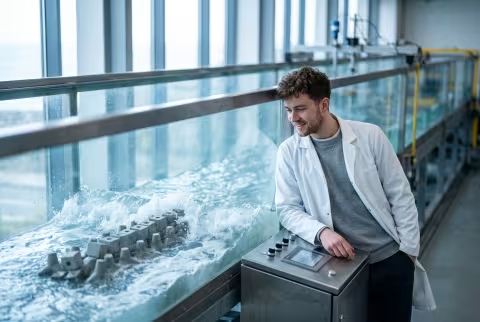
The aquaculture side is increasingly a water chemistry problem. Regional hatcheries have had crop failures that track periods of low pH in their intake water, and working out when to buffer and when to close the intake is a live operational question rather than a textbook one.
The partnership with a regional shellfish hatchery places two students each summer. Placement students work a full production season and several have been hired directly afterward.
Hatchery and farm production, fisheries management with state and federal agencies, seafood industry roles, consulting, and graduate study. The MS in Marine Resource Management takes graduates of this program most years.
Early mornings, animal husbandry that does not pause for weekends, and a fair amount of standing in water. Students who have worked on a boat or in a hatchery before tend to arrive knowing this.
The first-year foundation in marine life: cells, inheritance, evolution and the diversity of organisms, with the local shoreline as the standing example.
1How aquatic animals are grown: systems, species, water quality, nutrition and the economics that decide what is worth farming.
1The biology of fishes, from physiology and life history to the population processes that fisheries management depends on.
1Hatchery and grow-out production of oysters, clams and scallops, including the water chemistry problem that has made larval survival unpredictable.
1Turning catch records, survey data and biological sampling into a defensible number for how much can be taken.
1.5Environmental interaction, carrying capacity and certification — what makes a farm sustainable and who gets to say so.
1Yes, for all students entering directly from high school. Transfer students are housed as space allows, and the waitlist usually clears by mid-July.
Accordion content - Officiis porta iusto luctus maecenas ultricies libero quisquam commodi do sequi facilisis, accusamus aut? Sapien dignissim nascetur nesciunt phasellus eros dis cupidatat tempor egestas cillum eveniet lobortis, sunt eos tellus atque quaerat, voluptatem exercitationem voluptatibus nesciunt, eveniet in dicta quae.
Accordion content - Officiis porta iusto luctus maecenas ultricies libero quisquam commodi do sequi facilisis, accusamus aut? Sapien dignissim nascetur nesciunt phasellus eros dis cupidatat tempor egestas cillum eveniet lobortis, sunt eos tellus atque quaerat, voluptatem exercitationem voluptatibus nesciunt, eveniet in dicta quae.
Accordion content - Officiis porta iusto luctus maecenas ultricies libero quisquam commodi do sequi facilisis, accusamus aut? Sapien dignissim nascetur nesciunt phasellus eros dis cupidatat tempor egestas cillum eveniet lobortis, sunt eos tellus atque quaerat, voluptatem exercitationem voluptatibus nesciunt, eveniet in dicta quae.

Assistant Professor of Aquaculture
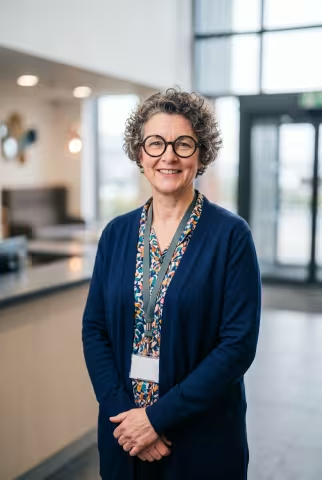
Professor of Fisheries Science