Case Study
Oceanography
The physics, chemistry and geology of the ocean, taught by a department that operates its own research vessel. Every student in this program goes to sea.

The physics, chemistry and geology of the ocean, taught by a department that operates its own research vessel. Every student in this program goes to sea.
Oceanography at Northmoor is a quantitative science degree. It is about how the ocean works as a physical and chemical system: why water moves where it does, what it carries, and how the whole thing couples to climate.
Every student in this program goes to sea aboard R/V Cascadia Strait. First-year students get a day trip. By the third year you may be running your own sampling station on a multi-day cruise, and by the fourth some students are writing their own science into a cruise plan.
The first year covers introductory oceanography and earth systems alongside the mathematics and physics core. The second year splits into the sub-disciplines — physical oceanography, chemical oceanography — and the third adds ocean observing systems and circulation and climate.
The program requires a data analysis course, and that requirement was argued for by the faculty on the grounds that a student who cannot handle a messy time series cannot do the science. Ocean data are gappy, noisy and unevenly sampled. Learning to work with them honestly is half the training.
Graduate study, agency and laboratory science, offshore and environmental consulting, instrument and survey work, and a steady stream into data-heavy roles outside the field entirely — the analysis training transfers further than students expect.
The department's own PhD program takes a small number of students each year, and several have come up through this degree.
Mathematics, and more of it than students who chose the ocean for romantic reasons sometimes anticipate. Also genuine sea time: fourteen-day endurance, watch-standing, and weather that decides the schedule. Departures are never convenient.
The ocean as a physical, chemical, geological and biological system. Taken by students across every program here.
1Plate tectonics, the rock cycle, surface processes and deep time — the physical foundation the marine geoscience sequence builds on.
1Ocean physics: the momentum balance, geostrophy, Ekman dynamics, and why water goes where it does.
1.5Seawater chemistry, nutrient cycling and the carbonate system, with coastal variability treated as the main event rather than as noise.
1How ocean measurements are actually made: sensors, moorings, autonomous platforms, and the failure modes of each.
1The ocean's role in the climate system: heat and carbon transport, variability, and how projections are built and where they are weakest.
1Working with real ocean data: gappy, noisy, unevenly sampled, and nothing like a textbook dataset.
1.5Yes, for all students entering directly from high school. Transfer students are housed as space allows, and the waitlist usually clears by mid-July.
Accordion content - Officiis porta iusto luctus maecenas ultricies libero quisquam commodi do sequi facilisis, accusamus aut? Sapien dignissim nascetur nesciunt phasellus eros dis cupidatat tempor egestas cillum eveniet lobortis, sunt eos tellus atque quaerat, voluptatem exercitationem voluptatibus nesciunt, eveniet in dicta quae.
Accordion content - Officiis porta iusto luctus maecenas ultricies libero quisquam commodi do sequi facilisis, accusamus aut? Sapien dignissim nascetur nesciunt phasellus eros dis cupidatat tempor egestas cillum eveniet lobortis, sunt eos tellus atque quaerat, voluptatem exercitationem voluptatibus nesciunt, eveniet in dicta quae.
Accordion content - Officiis porta iusto luctus maecenas ultricies libero quisquam commodi do sequi facilisis, accusamus aut? Sapien dignissim nascetur nesciunt phasellus eros dis cupidatat tempor egestas cillum eveniet lobortis, sunt eos tellus atque quaerat, voluptatem exercitationem voluptatibus nesciunt, eveniet in dicta quae.

Professor of Physical Oceanography
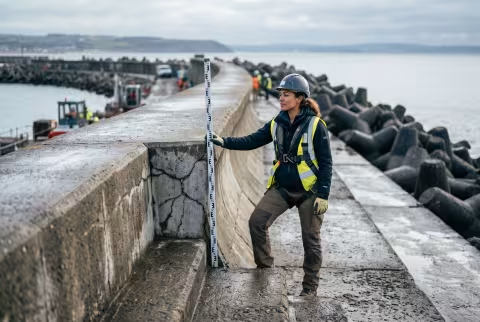
A professional master's for people who will make decisions about a shoreline that is moving. Taught jointly by the policy and ocean science departments.